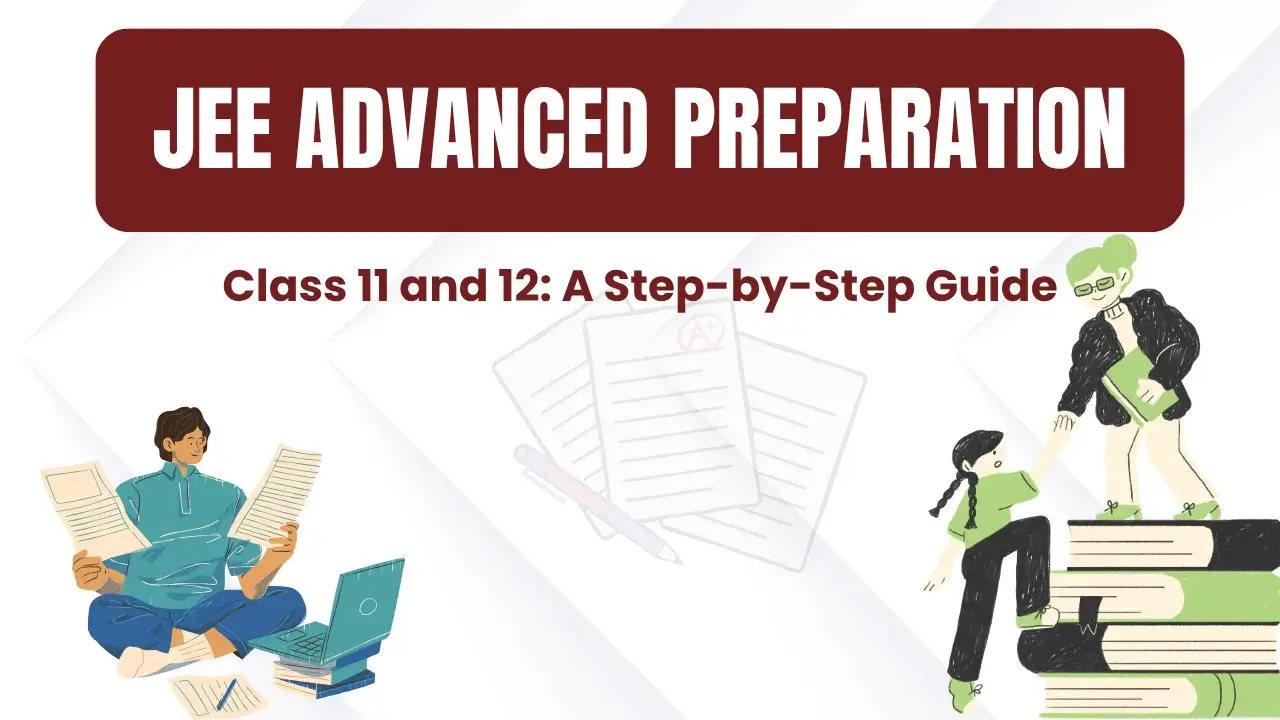
Starting your JEE Advanced preparation in Class 11 gives you the winning edge that most successful IIT aspirants leverage. If you’re wondering how to prepare for JEE Advanced from Class 11, you’re already ahead of the curve by planning early.
This comprehensive guide provides an actionable, realistic strategy to help you build a rock-solid foundation during Class 11 and cruise through Class 12 with confidence.
The Class 11 Advantage: Setting Yourself Apart from 2.5 Lakh Competitors
When you prepare for JEE Advanced from 11, you’re not just studying earlier—you’re building a strategic advantage that compounds over two years. Here’s the reality: JEE Advanced accepts only 2.5 lakh candidates (top performers in JEE Main), and from these, barely 48,000-50,000 secure IIT seats.
What Makes Class 11 Different:
Starting early transforms your preparation from a race into a systematic journey. You have approximately 20-24 months versus 8-10 months for latecomers. This extended timeline allows for deeper conceptual understanding, multiple practice cycles, and crucially—time to make and learn from mistakes without pressure.
The Mathematics of Early Preparation:
- Class 11 syllabus: ~45-50% of total JEE Advanced content
- Available study time in Class 11: ~1,200 hours (vs 600 hours in Class 12)
- Revision cycles possible: 3-4 complete cycles (vs 1-2 if started late)
- Stress level: Moderate and manageable (vs high pressure in Class 12)
According to successful IIT-JEE toppers, students who begin structured preparation in Class 11 report 35-40% higher confidence levels during the actual exam and handle pressure situations significantly better.
Read Also: JEE Advanced 2025 Syllabus with Chapter-Wise Weightage & Important Topics
Understanding JEE Advanced: What You’re Preparing For
Before diving into books, understand the exam structure. JEE Advanced is conducted by the IITs for admission to their undergraduate engineering programs. The exam consists of two papers (Paper 1 and Paper 2), each covering Physics, Chemistry, and Mathematics.
Exam Pattern Highlights:
- Duration: 3 hours per paper
- Question Types: Multiple choice, numerical value, matching type
- Negative Marking: Yes (varies by question type)
- Language Options: Available in multiple Indian languages
According to the official JEE Advanced website, approximately 2.5 lakh students qualify for the exam annually, but only the top 40,000-50,000 make the cut based on their JEE Main performance.
Month-by-Month Action Plan for Class 11
April – June: Foundation Building Phase
This is when you transition from Class 10 to Class 11. Use this period to get comfortable with the increased difficulty level.
Physics Focus Areas:
- Units and Measurements: Master dimensional analysis
- Kinematics: Build strong visualization skills for motion problems
- Laws of Motion: Understand Newton’s laws with real-world applications
- Work, Energy, and Power: Develop problem-solving strategies
Chemistry Starting Points:
- Some Basic Concepts: Mole concept, stoichiometry, and percentage composition
- Atomic Structure: Quantum numbers, electronic configuration
- Classification of Elements: Periodic trends thoroughly
- Chemical Bonding: Hybridization, molecular orbital theory
Mathematics Essentials:
- Sets, Relations, and Functions: Fundamental concepts
- Trigonometric Functions: All identities and transformations
- Complex Numbers: Algebra and geometric representation
- Straight Lines: Coordinate geometry basics
Action Steps:
- Complete NCERT thoroughly for all three subjects
- Start maintaining separate notebooks for formulas and shortcuts
- Solve 15-20 basic problems daily from each subject
- Join online JEE communities for peer learning
Stay consistent and goal-focused with our JEE Advanced 2026 Preparation Plan Month-wise (Free PDF) — your trusted guide to IIT success.
July – September: Intermediate Strengthening
Physics Progression:
- Rotational Motion: Moment of inertia concepts
- Gravitation: Universal law and planetary motion
- Mechanical Properties of Solids and Fluids
- Thermodynamics: Laws and their applications
Chemistry Development:
- States of Matter: Gas laws and kinetic theory
- Equilibrium: Chemical and ionic equilibrium
- Redox Reactions: Balancing complex equations
- Hydrogen and s-Block Elements
Mathematics Growth:
- Quadratic Equations: All methods of solving
- Sequences and Series: AP, GP, special series
- Permutations and Combinations: Fundamental counting principles
- Binomial Theorem: Expansions and applications
Action Steps:
- Increase problem-solving to 25-30 questions per subject daily
- Start taking weekly chapter tests
- Maintain an error log to track mistakes
- Watch video lectures for difficult concepts
October – December: Advanced Practice Phase
Physics Advancement:
- Kinetic Theory and Thermodynamics (complete)
- Oscillations and Waves: SHM thoroughly
- Begin revision of completed topics
Chemistry Mastery:
- Organic Chemistry basics: Nomenclature, isomerism
- Hydrocarbons: Reactions and mechanisms
- p-Block Elements Part 1
Mathematics Excellence:
- Conic Sections: All curves and properties
- Introduction to Three Dimensional Geometry
- Statistics and Probability basics
Action Steps:
- Take first full-length mock test (Class 11 syllabus only)
- Solve previous year JEE Main questions from covered topics
- Start referring to advanced books alongside NCERT
- Schedule weekly revision of older chapters
January – March: Consolidation and First Revision
Primary Objectives:
- Complete all Class 11 topics
- First complete revision of entire Class 11 syllabus
- Strengthen weak areas identified through tests
- Prepare for year-end school examinations
Action Steps:
- Take 2-3 full-length Class 11 syllabus tests
- Create mind maps for quick revision
- Solve topic-wise previous year questions
- Analyze your performance metrics thoroughly
Subject-Wise Preparation Strategy
Physics: Building Intuition and Analytical Thinking
Physics in JEE Advanced tests your conceptual clarity and application skills. The key is understanding “why” behind every formula.
Recommended Study Resources:
- NCERT Physics (Class 11 & 12) – Foundation
- Concepts of Physics by H.C. Verma – Problem-solving skills
- Problems in General Physics by I.E. Irodov – Advanced practice (selective problems)
- DC Pandey Series – Comprehensive coverage
Physics Study Techniques:
- Derive every formula once yourself to understand its origin
- Practice drawing diagrams for every problem
- Solve numerical problems with different approaches
- Focus on understanding graph-based questions
- Relate concepts to everyday life phenomena
High-Weightage Topics to Prioritize:
- Mechanics (25-30% of paper)
- Electrodynamics (20-25%)
- Modern Physics (15-20%)
- Thermodynamics (10-15%)
Chemistry: Balancing Memory and Understanding
Chemistry requires both conceptual understanding and factual memory. The three branches need different approaches.
Recommended Study Resources:
- NCERT Chemistry – Core foundation
- Physical Chemistry by O.P. Tandon – Numerical practice
- Organic Chemistry by Morrison and Boyd – Mechanism mastery
- Concise Inorganic Chemistry by J.D. Lee – Comprehensive theory
Chemistry Study Techniques:
- Physical Chemistry: Focus on numerical problem-solving daily
- Organic Chemistry: Understand reaction mechanisms, don’t memorize
- Inorganic Chemistry: Create colorful charts and mnemonics
- Practice writing balanced equations regularly
- Maintain a separate notebook for named reactions
Strategic Approach:
- Physical Chemistry: 40% of study time (high scoring potential)
- Organic Chemistry: 35% of study time (requires consistent practice)
- Inorganic Chemistry: 25% of study time (requires memory retention)
Mathematics: Developing Problem-Solving Speed
Mathematics in JEE Advanced demands both conceptual clarity and rapid calculation skills.
Recommended Study Resources:
- NCERT Mathematics – Fundamental concepts
- Plane Trigonometry by S.L. Loney – Trigonometry mastery
- Coordinate Geometry by S.L. Loney – Geometry excellence
- Higher Algebra by Hall and Knight – Algebra depth
- Problems in Calculus of One Variable by I.A. Maron – Calculus practice
Mathematics Study Techniques:
- Solve problems without calculator to improve mental math
- Learn shortcut methods for common problem types
- Practice mixed problem sets combining multiple topics
- Time yourself while solving to build speed
- Review solutions to understand alternate methods
Daily Practice Target:
- Basic level: 30 problems
- Intermediate level: 20 problems
- Advanced level: 10 problems
Creating Your Personalized Study Schedule
A realistic study schedule for Class 11 should balance school, JEE preparation, and personal well-being.
Sample Weekly Schedule:
Monday to Friday (School Days):
- 6:00 AM – 7:00 AM: Morning revision (formulae, quick concepts)
- 4:00 PM – 6:00 PM: Physics study and problem-solving
- 6:30 PM – 8:30 PM: Chemistry topics and practice
- 9:00 PM – 11:00 PM: Mathematics problem-solving
- 11:00 PM – 11:30 PM: Day revision and error analysis
Saturday (Deep Study Day):
- 7:00 AM – 9:00 AM: Weak topic strengthening
- 10:00 AM – 1:00 PM: Advanced problem-solving session
- 3:00 PM – 6:00 PM: Chapter test or mock test
- 7:00 PM – 9:00 PM: Test analysis and doubt clearing
Sunday (Revision Day):
- 8:00 AM – 11:00 AM: Weekly revision of all topics covered
- 12:00 PM – 2:00 PM: Previous year question practice
- 4:00 PM – 6:00 PM: Concept videos for difficult topics
- Evening: Complete rest or hobby time
Important Notes:
- Adjust timings based on your school schedule
- This represents study time BEYOND school hours
- Include 30-minute breaks between sessions
- Sleep 7-8 hours daily without compromise
Looking for the best coaching for JEE Advanced 2025? Check out our guide on Top Coaching Institutes for JEE Advanced 2025: Online vs Offline to choose the right one for your success.
Study Material Selection Guide
Choosing the right books prevents information overload and confusion.
Essential Books for Class 11:
| Subject | Basic Level | Intermediate Level | Advanced Level |
| Physics | NCERT + HC Verma Vol 1 | DC Pandey | Irodov (selective) |
| Chemistry | NCERT + OP Tandon | MS Chauhan (Organic) | JD Lee + Advanced Problems |
| Mathematics | NCERT + RD Sharma | Cengage Series | Hall & Knight, SL Loney |
Digital Resources Worth Exploring:
- Khan Academy for concept clarity
- Physics Wallah for Hindi medium students
- Unacademy and Vedantu for structured courses
- MIT OpenCourseWare for advanced physics concepts
- Organic Chemistry Tutor YouTube channel
Warning: Don’t accumulate too many books. Master one book per subject before moving to advanced resources.
Testing Strategy: Your Progress Checkpoint
Regular testing helps identify gaps and builds exam temperament.
Class 11 Testing Timeline:
Months 1-3 (April-June):
- Weekly topic tests (30 minutes each)
- Focus on accuracy over speed
Months 4-6 (July-September):
- Bi-weekly chapter tests (1 hour)
- Start timing yourself
Months 7-9 (October-December):
- Weekly multi-chapter tests (1.5 hours)
- Introduce negative marking simulation
Months 10-12 (January-March):
- Monthly full-length Class 11 tests (3 hours)
- Analyze performance metrics thoroughly
Post-Test Analysis Checklist:
- Which topics caused most errors?
- Were mistakes conceptual or silly errors?
- What was your time management like?
- Which questions should you have skipped?
- What concepts need immediate revision?
📘 JEE Advanced Syllabus Completion Tracker
✅ Class 11 Topics
- ✔ Mechanics
- ✔ Thermodynamics
- ✔ Chemical Bonding
- ✔ Basic Algebra & Trigonometry
- ✔ Atomic Structure
- ✔ Coordinate Geometry
✅ Class 12 Topics
- ✔ Electrostatics & Magnetism
- ✔ Organic Chemistry (All Mechanisms)
- ✔ Differential Calculus
- ✔ Modern Physics
- ✔ Surface Chemistry
- ✔ Integration & Application
💡 Use checkboxes or highlighters to track your progress visually. Color-coding subjects helps boost retention and motivation!
Common Mistakes to Avoid
Learning from others’ mistakes saves precious time and effort.
Critical Errors to Prevent:
- Neglecting NCERT: Many students skip NCERT thinking it’s too basic. Wrong! Nearly 20-25% of JEE Advanced questions are NCERT-based.
- Jumping to Advanced Books Too Early: Building a skyscraper needs a strong foundation. Master basics before attempting Irodov.
- Ignoring School Classes: Your school syllabus overlaps significantly with JEE. Paying attention in class saves study time later.
- Irregular Study Patterns: Studying 12 hours on Sunday and zero hours on Monday doesn’t work. Consistency beats intensity.
- Not Revising Regularly: Without periodic revision, you’ll forget topics faster than you learn new ones.
- Comparing with Peers: Everyone has a different pace. Focus on your growth, not others’ progress.
- Sacrificing Health: Burning out in Class 11 means you’ll have nothing left for Class 12. Health is non-negotiable.
For smart preparation, check our detailed guide on JEE Books IIT Toppers Recommended for 2025 covering the best Physics, Chemistry, and Maths books for JEE Advanced.
Mental Health and Motivation Management
JEE preparation is a marathon, not a sprint. Mental resilience matters as much as academic preparation.
Stress Management Techniques:
- Practice 10 minutes of meditation or deep breathing daily
- Engage in physical activity for at least 30 minutes
- Maintain a hobby unrelated to academics
- Connect with friends and family regularly
- Don’t hesitate to seek professional counseling if overwhelmed
Staying Motivated Through Challenges:
- Set weekly micro-goals instead of just the big JEE goal
- Celebrate small victories (completed a chapter, scored well in test)
- Visualize yourself at your dream IIT campus
- Join study groups with serious aspirants
- Read success stories of previous year toppers
Signs You Need to Pause and Reset:
- Consistent sleep deprivation
- Loss of interest in all activities
- Inability to concentrate even on easy topics
- Frequent irritability or mood swings
- Physical symptoms like headaches or body pain
Remember: Taking a break is not giving up. It’s refueling for the journey ahead.
Balancing School and JEE Preparation
Your school performance matters too, especially for board exams in Class 12.
Integration Strategy:
- Use school classes to understand basic concepts
- Complete school homework as JEE practice
- School exam preparation = revision of JEE topics
- Maintain good relationships with teachers for doubt clearing
- Score well in Class 11 finals to build momentum
Handling Multiple Coaching Formats:
If you’re in coaching classes:
- Don’t miss classes for self-study without strong reason
- Complete coaching assignments on time
- Utilize doubt sessions effectively
- Take all scheduled tests seriously
If you’re self-studying:
- Create strict accountability systems
- Join online test series
- Find a mentor or senior for guidance
- Utilize free resources optimally
Transition Plan: Class 11 to Class 12
The summer break between Class 11 and 12 is crucial preparation time.
Pre-Class 12 Checklist (March-April):
- Complete Class 11 syllabus revision at least twice
- Take 5-6 full-length mock tests (Class 11 syllabus)
- Identify and strengthen weak topics
- Start getting comfortable with Class 12 NCERT
- Create comprehensive formula sheets for quick revision
Setting Up for Success in Class 12:
- Your Class 11 foundation determines Class 12 success
- Well-prepared Class 11 students need only 4-5 months for Class 12 syllabus completion
- This leaves adequate time for multiple revisions and advanced practice
- You’ll handle board exam pressure much better with strong basics
| Aspect | Class 11 Strategy | Class 12 Strategy |
|---|---|---|
| Focus Area | Concept building and syllabus coverage | Advanced problem-solving and revision |
| Subject Priority | Balanced focus across all subjects | Slight emphasis on Class 12 topics + integration |
| Mock Tests | Topic-wise & chapter-wise tests | Full-length and timed mock tests |
| Revision Plan | Weekly review of learned chapters | Daily revision cycles + error tracking |
Additional Resources and Support Systems
Official Resources:
- National Testing Agency (JEE Main) – for JEE Main updates
- IIT JEE Advanced Official Portal – for exam pattern and syllabus
- NCERT Official Website – for downloading free textbooks
Community Support:
- Reddit’s r/JEENEETards – peer discussions and doubt clearing
- Telegram JEE preparation groups – daily motivation and resources
- Quora JEE spaces – expert advice and success stories
Mental Health Resources:
- NIMHANS Helpline for student stress management
- Your school counselor for academic guidance
- Parents and teachers as your primary support system
Success Metrics: Tracking Your Progress
Class 11 Year-End Benchmarks:
By the end of Class 11, you should achieve:
- 80%+ accuracy in NCERT-based questions
- Comfortable solving HC Verma level problems
- Complete one full revision of entire Class 11 syllabus
- Scored 120-150/360 in full-length mock tests
- Clear understanding of all fundamental concepts
If you’re below these benchmarks, don’t panic. Use the summer break to bridge gaps.
Your Action Plan Starts Today
The journey to prepare for JEE Advanced from 11 begins with a single step. Here’s what to do right now:
Today:
- Download the official JEE Advanced syllabus
- List all topics you’ve already covered in school
- Buy or collect essential NCERT books
- Create a dedicated study space at home
- Set a realistic daily study hour commitment
This Week:
- Complete one NCERT chapter from each subject
- Solve all NCERT exercises completely
- Create your first weekly study schedule
- Join one online JEE preparation community
- Take your first topic test
This Month:
- Complete 3-4 chapters per subject
- Start maintaining formula sheets
- Take your first chapter test
- Identify one weak area and strengthen it
- Establish a consistent daily study routine
Final Thoughts
Preparing for JEE Advanced from Class 11 is not about studying 15 hours daily or solving thousands of problems. It’s about consistent, focused effort with smart planning and regular self-assessment.
Remember these golden principles:
- Consistency over intensity – 5 hours daily beats 15 hours once a week
- Understanding over memorization – concepts stay, formulas fade
- Quality over quantity – solve 10 problems perfectly rather than 50 hastily
- Balance over obsession – maintain health, relationships, and hobbies
Thousands of students crack JEE Advanced every year with focused preparation starting from Class 11. With the roadmap provided in this guide, you now have a clear, actionable strategy to join their ranks.
Your dream IIT branch awaits. The question isn’t whether you can do it—it’s whether you’re willing to commit to the journey. Start today, stay consistent, and success will follow.
“Download the Official & Latest JEE Advanced Brochure- Click here“
Your transformation into an IIT student begins now. Make Class 11 count.
Frequently Asked Questions (FAQs)
mid-Class 11.
Last Updated: November 2025 | For latest exam updates, always refer to official JEE Advanced website
Read Also:
OJEE 2025 E-Counselling Begins – Step-by-Step Process & Choice Lock Tips

JEE Advanced 2026 Preparation Plan Month-wise (Free PDF) – Your Complete Success Roadmap

30-Day Smart Study Plan for JEE Advanced 2025: Maximize Your Last Month Preparation