
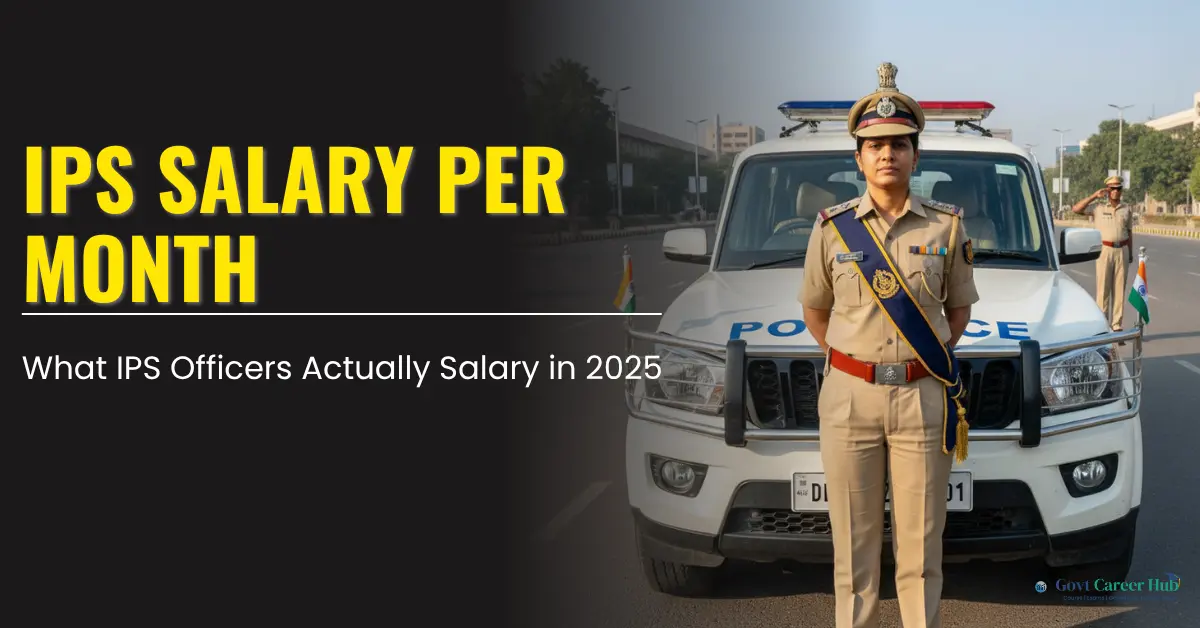
The Indian Police Service salary per month has always been a topic of interest for aspirants preparing for the UPSC Civil Services Examination. As one of the most prestigious uniformed services in the country, IPS officers not only shoulder the responsibility of maintaining law and order but also receive attractive financial compensation that reflects their critical role in society.
Understanding the actual earnings, allowances, and benefits can help you make an informed decision about pursuing this career path. Let’s break down exactly what IPS officers earn at different stages of their career.
Entry-Level Indian Police Service Salary Per Month
When you join as an IPS officer, your basic pay starts at ₹56,100 per month. However, this is just the foundation of your total earnings.
With Dearness Allowance, House Rent Allowance, and Travel Allowance included, your gross salary reaches approximately ₹79,662 per month. After mandatory deductions for provident fund, insurance, and income tax, the take-home salary stands at around ₹67,696.
For freshly appointed Deputy Superintendent of Police (DSP) or Assistant Commissioner of Police (ACP), the in-hand salary typically ranges from ₹70,000 to ₹1,00,000 per month depending on the posting location and applicable allowances.
If Maths feels challenging, UPSC Without Maths: Cracking Civil Services will help you find the right strategy.
IPS Officer Career Progression
From Entry to Apex: Salary Growth Over Your Career
Years
Years
Years
Years
Years
💡 Key Insight: Your salary grows by over 240% from entry level to apex scale, with structured promotions based on merit and tenure.
Rank-Wise IPS Officer Salary Structure
The Indian Police Service salary per month increases substantially as officers progress through various ranks. Here’s what you can expect at different career stages:
Junior Scale (0-4 years)
- Basic Pay: ₹56,100
- Typical Rank: Deputy Superintendent of Police (DSP), Assistant Commissioner of Police (ACP)
- Gross Monthly Income: ₹79,000 – ₹90,000
Senior Scale (After 5 years)
After completing five years of service, officers move to the Senior Time Scale with a basic pay of ₹67,700. The total salary for this grade, including allowances, ranges from ₹1,00,000 to ₹1,10,000 per month.
Junior Administrative Grade (After 9 years)
- Basic Pay: ₹78,800
- Total Monthly Income: ₹1,20,000 – ₹1,30,000
- Typical Rank: Superintendent of Police (SP)
Selection Grade (After 14-16 years)
Officers with around 16 years of service earn a basic pay of ₹1,18,500 in the Selection Grade. When including allowances, the total monthly salary ranges from ₹1,60,000 to ₹1,70,000.
Senior Administrative Grade
Deputy Inspector General (DIG) rank commands a monthly salary of ₹1,31,100, while Inspector General grade officers draw ₹1,44,200.
Apex Scale (25-30 years)
The highest salary of an IPS officer is ₹2,25,000 per month at the Director General of Police rank. With allowances, gross earnings can reach ₹2,70,000 per month.
For a structured approach to every subject in the prelims, read UPSC Prelims 2025: The Ultimate Subject-Wise Study Plan That Actually Works for Beginners.
Understanding Your IPS Compensation
More Than Just Salary: Complete Benefits Package
Basic Pay
Foundation of salary structure, increases with promotions and increments
Dearness Allowance
Revised twice yearly (Jan & July) to offset inflation impact
House Rent Allowance
Based on city classification and cost of living
Travel Allowance
Fixed component for official commuting expenses
Beyond Salary: Premium Benefits
💰 Total Value: When accounting for all benefits, the actual compensation package is significantly higher than the base salary alone, often worth an additional 40-60% of monetary value.
Understanding IPS Salary Components
The Indian Police Service salary per month comprises several distinct components that collectively determine your total earnings:
1. Basic Pay
This forms the core of your salary structure and serves as the foundation for calculating other allowances. It increases with promotions and time-based increments.
2. Dearness Allowance (DA)
The Central Government raised the Dearness Allowance to 53% of basic pay, effective July 1, 2024. DA is reviewed and updated twice a year, specifically in January and July, to offset the impact of inflation.
3. House Rent Allowance (HRA)
HRA is calculated based on the city of posting—24%, 16%, or 8% of basic pay. Metropolitan cities naturally command higher HRA compared to smaller towns.
4. Travel Allowance (TA)
Officers receive transport allowance to cover commuting expenses for official duties. This remains a fixed component added to monthly earnings.
5. Special Duty Allowance
When posted in sensitive areas or assigned special responsibilities, IPS officers receive additional allowances to compensate for the challenging work environment.
For a smart approach to syllabus priority, explore Most Scoring Subjects in UPSC Prelims: How to Prioritize Syllabus for Maximum Success.
Additional Perks Beyond Monthly Salary
The true value of an IPS career extends far beyond the Indian Police Service salary per month. Officers enjoy numerous benefits that significantly enhance their quality of life:
Accommodation Benefits
IPS officers receive rent-free government accommodation, with spacious bungalows in metropolitan areas and a minimum of 2 BHK accommodations in other locations.
Transportation
Each officer receives an official car with a driver or chauffeur for official and personal use. Senior officers may have access to multiple vehicles.
Healthcare
Free healthcare is provided for officers and their dependents under government medical schemes, eliminating significant healthcare expenses.
Security and Support Staff
IPS officers receive three house guards and two bodyguards for protection, with flexibility to arrange their security cover. Private housekeepers are also provided to handle daily tasks at their official residence.
Utility Subsidies
Electricity, water, and telephone bills are often subsidized or fully covered. Officers receive three BSNL SIM cards and a home landline with complimentary talk time, SMS, and internet services.
Professional Development
After nine years of service, officers are eligible to take a 2-4 year study break and are permitted to study abroad.
Retirement Benefits
IPS officers receive a lifelong pension and additional benefits, which extend to their spouses in the event of their passing. Additional perks include leave encashment, CGHS medical coverage, and gratuity.
Career Progression and Salary Growth
One of the most attractive aspects of the Indian Police Service salary per month is the structured career progression. Unlike many private sector jobs, IPS offers predictable advancement based on merit and years of service.
The timeline for promotions generally follows a well-defined structure, with merit and seniority rewarded adequately. Typically, after a decade in service, an IPS officer reaches the rank of Superintendent or Deputy Inspector General, depending on the cadre and performance.
After 10 years of service, IPS officers experience a major rise in their pay scale, resulting in higher basic pay and allowances, with the Dearness Allowance updated regularly.
IPS vs IAS Salary Comparison
Many aspirants wonder how the Indian Police Service salary per month compares to IAS officers. Both IAS and IPS officers begin their careers with a basic pay of ₹56,100 per month, excluding allowances.
However, an IAS officer can earn up to ₹2,50,000 at the highest level (Cabinet Secretary), while an IPS officer’s maximum salary is ₹2,25,000 (Director General of Police). This difference in pay comes from the different tasks and responsibilities each role has, with IAS officers having more varied and extensive duties.
Training Period Salary
Even during the rigorous training phase, IPS officers start receiving their salary. Officers receive a salary of ₹56,100 from day one, with ₹10,000 deducted for hostel and mess charges.
The training spans two years, beginning with a three-month foundational course at Lal Bahadur Shastri National Academy, followed by specialized training at the Sardar Vallabhbhai Patel National Police Academy in Hyderabad.
Location-Based Salary Variations
While the basic pay structure remains uniform nationwide, IPS officers posted in high-cost cities like Delhi or Mumbai receive higher allowances, such as House Rent Allowance and transport allowances, adjusted based on the cost of living.
This ensures that officers maintain a comfortable standard of living regardless of their posting location, with metropolitan assignments compensating for the higher living expenses.
Impact of 7th Pay Commission
Since January 2016, the Indian government has implemented the 7th Central Pay Commission, which introduced a new Pay Matrix system. This replaced the earlier Grade Pay structure with Consolidated Pay Levels, simplifying the salary calculation process.
The 7th Pay Commission significantly enhanced the financial prospects for IPS officers across all ranks, making the service more financially attractive while maintaining the focus on merit-based advancement.
What Motivates People Beyond Salary
While the Indian Police Service salary per month is certainly attractive, most officers are driven by factors beyond financial compensation. The opportunity to serve the nation, maintain law and order, and make a tangible difference in people’s lives provides immense satisfaction.
It’s crucial to remember that a career in the IPS should be driven by a higher calling – the opportunity to serve the nation. Aspiring officers should focus on developing qualities such as leadership, integrity, and a sense of duty.
The power to uphold justice, lead teams, and implement policies that affect millions of citizens makes this career uniquely fulfilling for those with a genuine commitment to public service.
For a quick overview of the recruitment process, see MPPSC Technical Cadre Recruitment 2025 – Apply Now.
Is IPS a High-Paying Career?
Yes, IPS is considered a well-paying job, especially at higher ranks, along with additional perks and allowances. When you factor in rent-free accommodation, official vehicles, healthcare coverage, security, and utility subsidies, the total compensation package far exceeds the basic monthly salary.
For someone starting their career, the combination of financial security, professional respect, career stability, and the opportunity for meaningful work makes IPS one of the most rewarding career choices in India.
Final Thoughts
The Indian Police Service salary per month provides financial stability and comfort, but it’s the comprehensive benefits package and career progression that truly set this service apart. From an entry-level salary of ₹56,100 rising to ₹2,25,000 at the apex, coupled with extensive allowances and perks, IPS offers one of the best compensation structures in government service.
However, the real value lies in the opportunity to lead, serve, and make a lasting impact on society. If you’re passionate about maintaining law and order, preventing crime, and serving your nation with integrity, the financial rewards are simply the icing on the cake of a truly fulfilling career.
For more information about UPSC preparation and civil services careers, visit the Union Public Service Commission official website or check the Department of Personnel and Training portal for the latest updates on pay structures and allowances.
Frequently Asked Questions About IPS Salary
Related Articles You Might Find Helpful:
- UPSC 2026 Examination Calendar: Complete Schedule, Important Dates
- Can You Crack UPSC Without Coaching? Success Stories & Tips
- How to Start UPSC Preparation from Zero Level- The Best Guide
Stay updated with the latest government career news and salary information at GovtCareerHub.com