
Finding a government job that offers both accessibility and excellent pay is the dream of millions of Indian job seekers. If you’re looking for easy government jobs with high salary potential, you’re in the right place. This comprehensive guide breaks down the most attainable government positions that offer attractive compensation packages, helping you make informed career decisions in 2025.
What Makes a Government Job “Easy” Yet High-Paying?
Understanding which government jobs qualify as “easy” helps you make smarter career choices. An easy government job typically means positions with straightforward exam patterns, clear syllabi, multiple attempts allowed, and accessible educational requirements.
Key factors that make government jobs easier:
Simplified Exam Patterns: Unlike competitive exams requiring years of preparation, jobs like Bank Clerk, SSC CHSL, and Railway Group D have well-defined syllabi with objective-type questions. Study materials are abundantly available, and the pattern remains consistent across years.
Lower Educational Barriers: Many high-paying positions require only 10th or 12th pass certificates. For instance, Railway Technicians and SSC MTS positions offer salaries above ₹20,000 monthly with just secondary education.
Multiple Opportunities: Organizations like SSC, Railways, and Banking sectors conduct recruitments multiple times annually. If you miss one, another opportunity arrives within months, unlike limited-vacancy exams.
No Interview Pressure: Positions like IBPS Clerk and SSC MTS don’t require interviews. Your written exam score determines selection, eliminating subjective evaluation stress.
High Success Rates: According to the Centre for Monitoring Indian Economy (CMIE), banking and railway sectors show higher selection ratios compared to prestigious services like UPSC, making them more accessible for average candidates.
Age Flexibility: Most easy government jobs allow candidates between 18-30 years (with relaxations), giving you multiple attempts over several years to succeed.
The combination of accessibility and attractive salary packages (ranging from ₹20,000 to ₹80,000 monthly) makes these positions ideal for those seeking stable careers without extremely competitive preparation requirements.
📘 Read: SSC CGL Syllabus 2026 – Complete Overview.
Top 10 Easy Government Jobs with High Salary
1. Banking Sector Positions
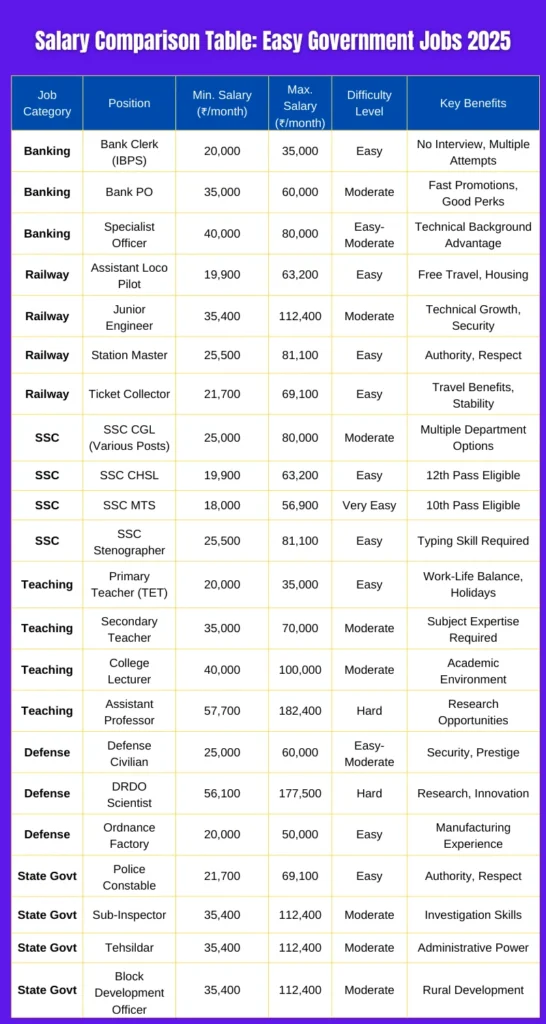
Banking jobs offer one of the most accessible entry points into government service with competitive salaries and clear career progression paths.
Bank Clerk (IBPS Clerk)
- Monthly Salary: ₹20,000 – ₹35,000
- Educational Requirement: Graduation in any discipline
- Key Advantage: No interview required, straightforward exam pattern
- Work Profile: Customer service, cash handling, basic banking operations
Bank Probationary Officer (PO)
- Monthly Salary: ₹41,960 – ₹77,490 (with allowances)
- In-hand Salary: ₹50,000 – ₹65,000 approximately
- Career Growth: Fast track to Branch Manager positions
- Responsibilities: Loan processing, customer relations, team management
Why banking jobs are easier: The syllabus is well-defined with abundant study materials available. Multiple attempts are permitted, and the success rate for dedicated candidates remains encouraging. The absence of interviews for clerical positions significantly reduces pressure.
Explore Latest Banking Job Vacancies →
2. Railway Recruitment Board (RRB) Jobs
Indian Railways remains one of the largest employers in the world, offering diverse positions with excellent job security and benefits.
Assistant Loco Pilot (ALP)
- Monthly Salary: ₹19,900 – ₹63,200
- Level: 2 (7th Pay Commission)
- Benefits: Free railway passes, medical facilities, quarters
Railway Technician
- Monthly Salary: ₹21,700 – ₹69,100
- Multiple trades available: Electrical, Mechanical, Fitter
- Regular technical training provided
Ticket Examiner/Travelling Ticket Examiner
- Monthly Salary: ₹25,500 – ₹81,100
- Travel benefits for family members
- Diverse work environment
The Indian Railways recruitment process is systematic and transparent, making it one of the easier government jobs to secure with proper preparation.
Check Current Railway Job Openings →
3. Staff Selection Commission (SSC) Jobs
The Staff Selection Commission conducts recruitment for various Group B and C positions across central government ministries. These positions offer excellent work-life balance with respectable salaries.
SSC Combined Graduate Level (CGL)
- Salary Range: ₹25,500 – ₹81,100
- Popular Posts: Income Tax Inspector, Assistant Audit Officer, Sub-Inspector (CBI)
- In-hand Salary: ₹40,000 – ₹60,000 (varies by position and location)
SSC Combined Higher Secondary Level (CHSL)
- Salary Range: ₹19,900 – ₹63,200
- Posts: Lower Division Clerk, Data Entry Operator, Postal Assistant
- Entry Requirement: 12th pass
SSC Multi-Tasking Staff (MTS)
- Salary Range: ₹18,000 – ₹56,900
- Basic educational requirement: 10th pass
- Simple exam pattern with multiple choice questions
Apply for Active SSC Examinations →
4. Teaching Positions
Teaching jobs provide stable careers with respectable social status and improving salary structures.
Primary Teacher (TET Qualified)
- Monthly Salary: ₹20,000 – ₹40,000 (state-dependent)
- Requirement: Bachelor’s degree + TET qualification
- Working Hours: Fixed school timings with long vacation periods
Trained Graduate Teacher (TGT)
- Monthly Salary: ₹35,000 – ₹70,000
- Subject specialization required
- Career advancement to Vice Principal roles
Post Graduate Teacher (PGT)
- Monthly Salary: ₹47,600 – ₹1,51,100 (7th Pay Commission)
- Higher educational institutions
- Research opportunities available
Government College Lecturer/Assistant Professor
- Monthly Salary: ₹57,700 – ₹1,82,400
- Requirement: NET/SET qualification
- Balance between teaching and research
Browse Teaching Job Opportunities →
5. Defense Civilian Posts
Defense organizations offer numerous civilian positions that don’t require combat training but provide excellent compensation and facilities.
Defense Civilian Employees
- Salary Range: ₹25,000 – ₹60,000
- Various departments: DRDO, Ordnance Factories, Military Engineering Services
- Technical and administrative positions available
DRDO Scientist ‘B’
- Monthly Salary: ₹56,100 – ₹1,77,500
- For engineering graduates
- Work on cutting-edge defense technology
Ordnance Factory Workers
- Salary Range: ₹20,000 – ₹50,000
- Semi-skilled and skilled positions
- Job security with production-based work
Explore Defense Sector Vacancies →
6. Public Sector Undertakings (PSU) Jobs
PSUs combine government job security with corporate-style benefits. Companies like ONGC, BHEL, and NTPC offer attractive packages.
PSU Engineer (Through GATE)
- Monthly Salary: ₹50,000 – ₹1,00,000
- Entry Level: Executive trainee
- Companies: ONGC, IOCL, BHEL, NTPC, Coal India
- Benefits: Performance bonuses, housing, medical insurance
PSU Management Trainee
- Monthly Salary: ₹40,000 – ₹80,000
- Finance, HR, and Marketing roles
- Fast career progression
7. State Police Services
Police recruitment offers multiple positions with varying educational requirements and good salary packages.
Police Constable
- Monthly Salary: ₹21,700 – ₹69,100
- Physical fitness required
- Job security and respect in society
Police Sub-Inspector
- Monthly Salary: ₹35,400 – ₹1,12,400
- Investigation powers
- Leadership roles
Police Head Constable
- Monthly Salary: ₹29,200 – ₹92,300
- Supervisory position
- Experience-based promotions
8. Postal Department Jobs
India Post offers diverse positions with nationwide presence and stable employment.
Postal Assistant/Sorting Assistant
- Monthly Salary: ₹25,500 – ₹81,100
- Office-based work
- Simple recruitment process
Postman/Mail Guard
- Monthly Salary: ₹18,000 – ₹56,900
- Outdoor field work
- Physical fitness required
9. State Administrative Services
State governments recruit for various administrative positions that offer good salaries and authority.
Tehsildar/Revenue Inspector
- Monthly Salary: ₹35,400 – ₹1,12,400
- Revenue administration
- Field and office work combination
Block Development Officer
- Monthly Salary: ₹44,900 – ₹1,42,400
- Rural development schemes
- Implementation authority
10. LIC Agent (Government Insurance Sector)
LIC Assistant
- Monthly Salary: ₹25,000 – ₹40,000
- Clerical and administrative work
- Insurance sector knowledge helpful
LIC Development Officer
- Earnings: Commission-based with high potential
- Monthly Income: ₹30,000 – ₹80,000+
- Flexibility with growth opportunities
Eligibility Criteria Breakdown
Educational Qualifications by Job Level
10th Pass Positions:
- Police Constable (in some states)
- SSC MTS
- Postal Department (certain positions)
- Railway Group D
12th Pass Positions:
- SSC CHSL (LDC, DEO)
- Railway Technicians
- Bank Clerk
- Defence Civilian Posts (some categories)
Graduate Level Positions:
- Bank PO
- SSC CGL
- State Civil Services
- Teaching positions (with B.Ed)
- PSU Entry-level positions
Post-Graduate Positions:
- College/University Professors
- DRDO/ISRO Scientists (with M.Tech/M.Sc)
- Specialized research positions
Age Limit Guidelines
Most government jobs follow these age restrictions:
- General Category: 18-30 years
- OBC (Other Backward Classes): 18-33 years (3 years relaxation)
- SC/ST (Scheduled Castes/Tribes): 18-35 years (5 years relaxation)
- Ex-Servicemen: Age relaxation as per service period
- PWD (Persons with Disabilities): Additional 10 years relaxation
Upper age limits vary by position and state. Always verify exact age criteria in official notifications.
Strategic Preparation Approach
1. Understand Your Target Exam Thoroughly
Success begins with complete clarity about your chosen examination. Download previous years’ question papers from official websites. Analyze the difficulty level, question types, and time requirements. Understand the marking scheme—many exams have negative marking for incorrect answers.
2. Create a Realistic Study Schedule
Map out your preparation timeline working backward from the exam date. Allocate more time to sections where you’re weak. Include regular revision sessions—experts recommend spending 30% of study time on revision. Build in buffer time for unexpected events.
3. Master General Knowledge and Current Affairs
Current affairs form a crucial component of most government exams. Read newspapers daily, focusing on:
- Government schemes and policies
- Economic developments
- International relations
- Scientific breakthroughs
- Sports and awards
Maintain a monthly current affairs notebook for quick revision.
4. Practice Quantitative Aptitude Regularly
Mathematical ability improves with consistent practice. Focus on:
- Simplification and approximation
- Percentage and ratio problems
- Data interpretation
- Time and work problems
- Profit and loss calculations
Solve at least 20-30 problems daily to maintain speed and accuracy.
5. Improve English Language Skills
English sections test comprehension, grammar, and vocabulary. Daily reading habits significantly improve performance. Practice:
- Reading comprehension passages
- Fill in the blanks
- Error detection
- Sentence improvement
- Vocabulary through context
6. Take Regular Mock Tests
Mock tests simulate actual exam conditions and are crucial for success. They help:
- Build time management skills
- Reduce exam day anxiety
- Identify weak areas requiring attention
- Improve question selection strategy
- Track progress over time
Start with full-length tests once your syllabus completion reaches 70%.
Understanding Government Salary Structure
The 7th Pay Commission governs salary structures for central government employees. Understanding this helps evaluate job offers accurately.
Pay Level System
The current system uses Pay Levels (1-18) instead of Pay Bands. Each level has defined entry pay and maximum pay with annual increments.
Salary Components Explained
Basic Pay: The fundamental salary component forming the base for other allowances.
Dearness Allowance (DA): Compensates for inflation, revised twice annually. Currently around 50% of basic pay for central government employees.
House Rent Allowance (HRA): Varies by city classification:
- X Class cities: 24% of basic pay
- Y Class cities: 16% of basic pay
- Z Class cities: 8% of basic pay
Transport Allowance: Covers commuting expenses, typically ₹3,600-₹7,200 monthly depending on city.
Medical Allowance: Fixed amount, with additional benefits through Central Government Health Scheme (CGHS).
Additional Financial Benefits
Provident Fund: Both employee and employer contribute 12% of basic pay, building retirement corpus.
Gratuity: Lump sum payment on retirement calculated as (Basic + DA) × 15/26 × years of service.
Pension: Monthly income after retirement, currently at 50% of last drawn basic pay plus DA.
Leave Encashment: Unused earned leave can be encashed at the time of retirement.
Smart Application Strategy
1. Track Multiple Recruitment Notifications
Don’t put all eggs in one basket. Apply for multiple positions matching your qualifications. Use:
- Employment News (weekly government publication)
- Official department websites
- GovtCareerHub.com for consolidated updates
- State employment portals
2. Meet Application Deadlines
Mark exam dates on calendars immediately after notification release. Apply at least 2-3 days before closing dates to avoid last-minute technical issues. Keep necessary documents scanned in advance:
- Photographs (recent, proper size)
- Signature specimen
- Educational certificates
- Caste/category certificates (if applicable)
- ID proof
3. Maintain Document Readiness
Create a dedicated folder with:
- Multiple photocopies of all certificates
- Self-attested copies
- Original documents in protective covers
- Category/disability certificates with validity
4. Verify Information Carefully
Review application forms thoroughly before submission. Most rejections occur due to:
- Incorrect email addresses or phone numbers
- Educational qualification mismatches
- Age calculation errors
- Incomplete application forms
- Wrong exam center selections
5. Save Confirmation Details
After successful submission:
- Download and print application forms
- Note down registration numbers
- Save payment receipts
- Keep email confirmations
- Store admit cards safely
Success Tips from Selected Candidates
Consistency Beats Intensity: Regular 4-5 hours daily study is more effective than irregular 10-hour marathon sessions.
Quality Over Quantity: Focus on understanding concepts thoroughly rather than covering excessive material superficially.
Stay Updated: Government policies and current affairs change rapidly. Allocate 30 minutes daily for news reading.
Join Study Groups: Collaborative learning helps clarify doubts and provides motivation. Choose serious, focused groups.
Health Matters: Maintain physical fitness through regular exercise. Mental alertness improves with good health habits.
Believe in the Process: Government exam preparation tests patience. Trust your preparation and stay committed despite setbacks.
Common Mistakes to Avoid
During Preparation Phase
Procrastination: Starting preparation “from tomorrow” is the biggest mistake. Begin immediately, even with just one hour daily.
Ignoring Weak Subjects: Address weaknesses instead of avoiding them. Weak areas cost maximum marks in exams.
No Revision Plan: Without regular revision, retention decreases significantly. Plan weekly and monthly revision cycles.
Over-reliance on Coaching: Coaching provides guidance, but self-study remains crucial. Develop independent problem-solving abilities.
During Application Phase
Incomplete Document Verification: Missing or incorrect documents lead to disqualification even after clearing exams.
Not Reading Instructions: Application forms have specific requirements. Reading instructions carefully prevents errors.
Multiple Accounts: Creating multiple registrations with different details leads to cancellation.
Payment Issues: Keep multiple payment options ready. Transaction failures happen frequently near deadlines.
During Examination
Not Following Admit Card Instructions: Arrive at least 45 minutes early. Carry required documents and stationery.
Attempting All Questions: With negative marking, intelligent guessing is better than wild guessing. Skip questions you’re completely unsure about.
Time Mismanagement: Spending too long on difficult questions costs easier marks. Attempt known questions first.
Panic During Exam: If you face difficult sections, stay calm. Others are facing the same difficulty level.
Future Career Growth in Government Jobs
Government employment isn’t static—it offers structured growth opportunities.
Promotion Mechanisms
Time-bound Promotions: Automatic promotions after specific service periods (usually 4-5 years per grade).
Performance-based Advancement: Fast-track promotions for exceptional performers through Annual Confidential Reports (ACRs).
Departmental Examinations: Internal competitive exams allow faster career progression.
Deputation Opportunities: Experience different departments and locations through temporary postings.
Skill Enhancement Programs
Government departments invest heavily in employee development:
- Regular training programs on new technologies
- Sponsored higher education opportunities
- Professional certifications funded by department
- Foreign training opportunities for deserving candidates
- Leadership development programs for management roles
Lateral Movement
Government employees can:
- Move between departments through proper channels
- Apply for central services through limited departmental competitive examinations
- Utilize their experience for higher positions in state services
Conclusion: Your Path Forward
Easy government jobs with high salary are achievable goals with systematic preparation and strategic planning. The key lies in identifying positions matching your qualifications, preparing thoroughly using proven methods, and maintaining persistence throughout your journey.
Success in government recruitment isn’t about extraordinary intelligence—it’s about disciplined effort, smart strategy, and consistent execution. Whether you’re a fresh graduate exploring career options or a working professional seeking stability, government employment offers the security and growth potential few private sector jobs can match.
Start your preparation journey today by:
- Identifying 3-5 positions matching your qualifications
- Creating a six-month study plan
- Gathering quality study materials
- Joining online forums or study groups
- Taking your first practice test to assess current levels
Visit GovtCareerHub.com regularly for:
- Latest recruitment notifications across all sectors
- Exam date announcements and updates
- Free study materials and previous papers
- Preparation tips from successful candidates
- Answer key discussions and cut-off analysis
Remember: Every successful government employee started exactly where you are now. The difference between those who succeed and those who don’t isn’t talent—it’s persistence. Your dream government job awaits on the other side of consistent, focused effort.
Important Disclaimer: Salary figures mentioned represent approximate ranges based on 7th Pay Commission recommendations and may vary by location, experience level, department policies, and allowances. Always refer to official recruitment notifications for exact and current compensation details. This guide is for informational purposes and does not guarantee job selection.
Frequently Asked Questions (FAQs)
You May Like Also:
- Easy Government Jobs After Graduation: Complete Guide 2025
- Highest Paying Government Jobs India: Complete Salary Guide 2025
- Which Govt Exam is Easy to Crack? Your Complete Guide to Landing a Government Job