
Agriculture remains the cornerstone of India’s economy, employing over 58% of the workforce and contributing significantly to national GDP. With technological advancements transforming traditional farming into agri-tech ventures, pursuing a Diploma in Agriculture After 12th has become a strategic career choice for students seeking practical knowledge and quick employment opportunities.
This comprehensive guide explores everything about agriculture diploma courses—from eligibility and admission processes to career prospects, salary packages, and top institutes in India for 2025.
Why Choose a Diploma in Agriculture After 12th?
A diploma in agriculture offers distinct advantages over conventional degree programs, making it an attractive option for students who want to enter the agricultural sector quickly and effectively.
Key Benefits:
- Shorter Duration: Most diploma programs range from 1 to 3 years, compared to the 4-year BSc Agriculture degree
- Practical Skill Development: Emphasizes hands-on training in crop production, soil management, and modern farming techniques
- Cost-Effective Education: Significantly more affordable than full-fledged undergraduate programs, with fees ranging from ₹10,000 to ₹40,000 per annum
- Early Career Entry: Students can start working immediately after course completion
- Government Job Eligibility: Diploma holders qualify for various agricultural officer and supervisor positions
- Entrepreneurship Opportunities: Provides foundational knowledge to start agribusiness ventures or commercial farming
According to the Indian Council of Agricultural Research (ICAR), India requires over 50,000 skilled agricultural professionals by 2030 to ensure food security and sustainable farming practices, creating abundant opportunities for diploma holders.
Eligibility for Agriculture Diploma: 2025 Requirements
Understanding the eligibility criteria is essential before applying to agriculture polytechnic colleges. Here are the updated requirements for 2025:
Educational Qualifications:
| Criteria | Details |
| Minimum Education | 10th or 12th pass from a recognized board (CBSE, ICSE, State Boards) |
| Minimum Percentage | 45-50% aggregate (40-45% for SC/ST/OBC categories) |
| Subject Requirements | Science subjects (Physics, Chemistry, Biology/Mathematics) preferred but not mandatory at all institutes |
| Age Limit | Typically 16-22 years (relaxation for reserved categories) |
Admission Process:
Most agriculture diploma admissions follow these pathways:
- Merit-Based Admission: Direct admission based on 10th/12th marks
- Entrance Examination: Some state agricultural universities conduct entrance tests
- Lateral Entry: Diploma holders may get lateral entry into BSc Agriculture (2nd year)
Popular Entrance Exams: ICAR AIEEA (All India Entrance Examination for Admission), KEAM (Kerala Engineering Architecture Medical), state-level polytechnic entrance tests.
Looking for the best government jobs after BSc for women? Read After BSc Government Jobs for Female: Best Career Paths & Exams in 2025.
Best Diploma Courses in Agriculture: Specializations Available
Agriculture diplomas offer various specializations catering to different interests and career paths:
Core Diploma Programs:
- Diploma in Agriculture (General)
- Diploma in Agricultural Sciences
- Diploma in Organic Agriculture
- Diploma in Seed Technology
- Diploma in Horticulture
- Diploma in Floriculture
- Diploma in Poultry Farming
- Diploma in Dairy Technology
- Diploma in Agricultural Engineering
- Diploma in Food Processing Technology
Each specialization equips students with sector-specific skills, increasing employability in targeted industries.
Interested in banking after BSc Agriculture? Read Banking Exams After BSc Agriculture: Your Gateway to a Rewarding Financial Career.
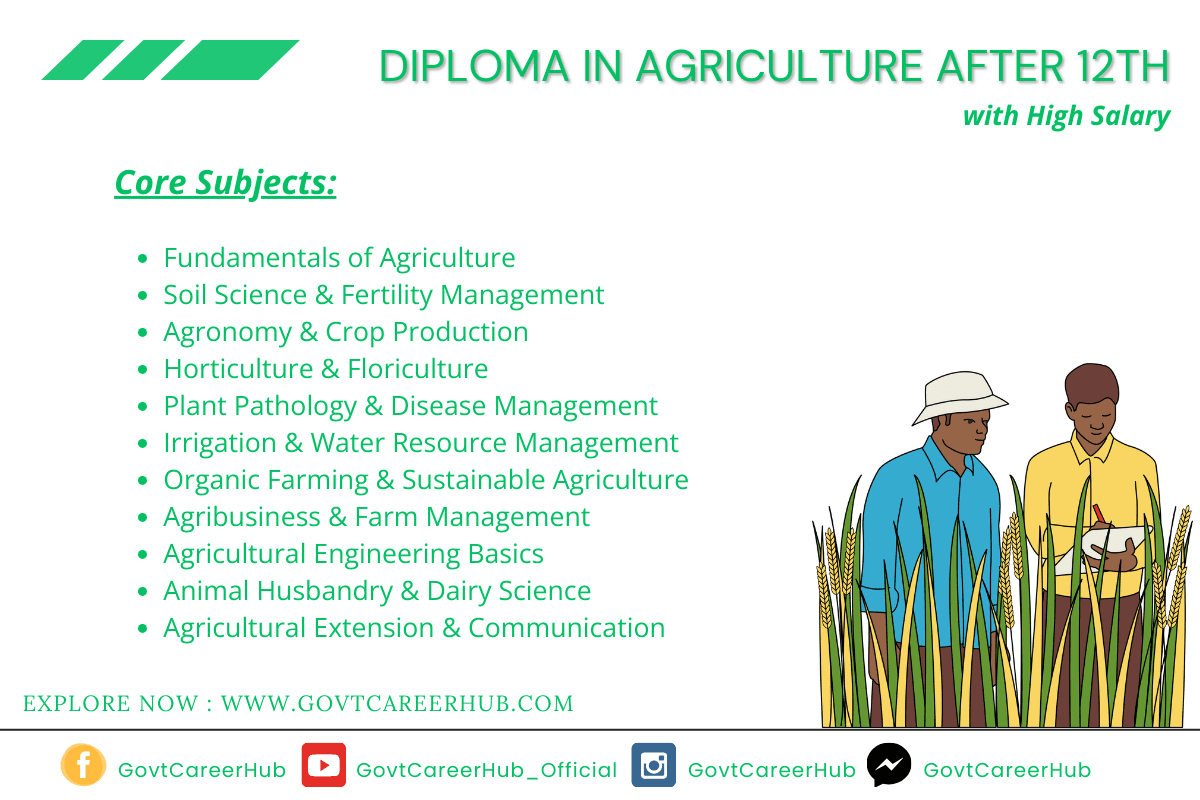
Diploma in Agriculture Syllabus: What You’ll Learn
The curriculum is designed to provide comprehensive knowledge of agricultural practices with practical exposure. Here’s a semester-wise breakdown:
First Year Subjects:
- Fundamentals of Crop Production
- Soil Science and Fertility Management
- Agricultural Chemistry and Biochemistry
- Plant Pathology and Disease Management
- Agricultural Meteorology
- Farm Machinery and Equipment
- Agricultural Economics and Marketing
Second Year Subjects:
- Agronomy and Cropping Systems
- Irrigation and Water Resource Management
- Organic Farming Practices
- Pest and Weed Management
- Horticulture and Vegetable Production
- Animal Husbandry Basics
- Agricultural Extension and Communication
- Practical Training and Field Work
Practical Training Components:
- Farm visits to Krishi Vigyan Kendras (KVKs)
- Hands-on experience with modern agricultural equipment
- Soil testing and analysis
- Crop monitoring and disease identification
- Internships at agricultural research stations
Confused about what to study after 12th for a government job? Read Which Course is Best for Government Jobs After 12th? Your Complete Career Guide for 2025.
Top Agriculture Polytechnic Colleges in India 2025
Choosing the right institute significantly impacts your learning experience and placement opportunities. Here are the leading institutions offering diploma courses:
Government Agricultural Universities:
| Institute | Location | Key Features |
| Punjab Agricultural University | Ludhiana, Punjab | ICAR-accredited, excellent placement support |
| Tamil Nadu Agricultural University | Coimbatore, Tamil Nadu | Strong research facilities, government job focus |
| Acharya N.G. Ranga Agricultural University | Guntur, Andhra Pradesh | Wide network of agricultural colleges |
| Kerala Agricultural University | Thrissur, Kerala | Specialized organic agriculture programs |
| Indira Gandhi Krishi Vishwavidyalaya | Raipur, Chhattisgarh | Affordable fees, tribal area focus |
| Dr. Balasaheb Sawant Konkan Krishi Vidyapeeth | Dapoli, Maharashtra | Coastal agriculture expertise |
| Chaudhary Charan Singh Haryana Agricultural University | Hisar, Haryana | Modern infrastructure, industry tie-ups |
Private Institutions:
| Institute | Location | Highlights |
| Lovely Professional University (LPU) | Phagwara, Punjab | ICAR-accredited, comprehensive placement cell |
| Amity University | Noida, Uttar Pradesh | Industry collaborations, modern labs |
| Parul University | Vadodara, Gujarat | Integrated farming exposure |
| Mangalayatan University | Aligarh, Uttar Pradesh | Affordable fees, hands-on training |
Application Timeline 2025: Most universities open admissions between May-July, with last dates extending till August-September. Early applications receive priority consideration.
Source: ICAR Official Portal
Career Options After Diploma in Agriculture: Government & Private Sectors
Diploma holders enjoy diverse career pathways across multiple sectors. Here’s a detailed breakdown:
Government Job Opportunities:
Agriculture diploma graduates are eligible for these positions through state and central government recruitments:
| Job Role | Recruiting Bodies | Salary Range (Per Annum) |
| Agricultural Officer | State Agriculture Departments | ₹3.5 – 5.5 LPA |
| Agriculture Extension Officer | Krishi Vigyan Kendras (KVKs) | ₹3 – 4.5 LPA |
| Horticulture Inspector | State Horticulture Boards | ₹2.8 – 4.2 LPA |
| Irrigation Supervisor | Irrigation Departments | ₹3 – 5 LPA |
| Soil Conservation Officer | Soil & Water Conservation Dept. | ₹3.5 – 5 LPA |
| Farm Manager (Govt Farms) | State Agriculture Corporations | ₹3 – 4.8 LPA |
| Agricultural Field Officer | NABARD, Public Sector Banks | ₹4 – 6.5 LPA |
Major Recruiters:
- Ministry of Agriculture & Farmers Welfare
- Indian Council of Agricultural Research (ICAR)
- National Bank for Agriculture and Rural Development (NABARD)
- State Agricultural Marketing Boards
- Fertilizers and Chemicals Travancore (FACT)
Private Sector Careers:
| Job Profile | Industry | Average Salary (Per Annum) |
| Agribusiness Manager | Agri-input companies | ₹4 – 7 LPA |
| Farm Supervisor | Corporate farming companies | ₹3 – 5.5 LPA |
| Seed Production Manager | Seed companies | ₹3.5 – 6 LPA |
| Agricultural Consultant | Private consultancies | ₹4 – 8 LPA |
| Quality Control Officer | Food processing units | ₹3 – 5 LPA |
| Sales Executive (Agri Products) | Fertilizer/pesticide companies | ₹2.5 – 5 LPA |
| Precision Farming Specialist | Agri-tech startups | ₹5 – 9 LPA |
Top Hiring Companies: ITC Limited, Godrej Agrovet, Rallis India, UPL Limited, Bayer CropScience, Mahindra Agribusiness, Jain Irrigation Systems.
Self-Employment & Entrepreneurship:
Many diploma holders successfully establish their own ventures:
- Organic Farming Business: Average annual profit ₹5-12 lakhs
- Commercial Nursery: Investment ₹2-5 lakhs, returns 40-60%
- Agricultural Equipment Rental Services: Growing demand in rural areas
- Agri-input Dealership: Fertilizers, pesticides, seeds distribution
- Contract Farming: Tie-ups with food processing companies
- Mushroom Cultivation: High-profit margin venture
- Hydroponics/Vertical Farming: Modern urban farming techniques
Salary After Agriculture Diploma: 2025 Industry Standards
Compensation varies based on sector, location, experience, and job role. Here’s a comprehensive salary analysis:
Entry-Level Salaries (0-2 Years):
| Experience Level | Government Sector | Private Sector | Self-Employment |
| Fresher | ₹2.5 – 4 LPA | ₹2 – 3.5 LPA | Variable (₹3-6 LPA) |
| 1-2 Years | ₹3.5 – 5 LPA | ₹3 – 5 LPA | ₹5-8 LPA |
Mid-Level Salaries (3-5 Years):
With experience and additional certifications, agriculture professionals see substantial growth:
- Supervisory Roles: ₹5 – 8 LPA
- Management Positions: ₹6 – 10 LPA
- Specialized Technical Roles: ₹7 – 12 LPA
Additional Income Opportunities:
- Freelance Consulting: ₹500-2,000 per farm visit
- Training and Workshops: ₹5,000-15,000 per session
- Government Scheme Implementation: Project-based payments
Salary Growth Factors:
- Additional certifications (Organic Farming, Precision Agriculture)
- Postgraduate qualifications (BSc/MSc Agriculture through lateral entry)
- Geographical location (urban vs. rural placements)
- Specialization in high-demand areas (agri-tech, sustainable farming)
Source: PayScale India, AmbitionBox, Glassdoor
Diploma vs. BSc Agriculture: Which Should You Choose?
Many students wonder whether to pursue a diploma or wait for a bachelor’s degree. Here’s a detailed comparison:
| Parameter | Diploma in Agriculture | BSc Agriculture |
| Duration | 1-3 years | 4 years |
| Eligibility | 10th/12th pass | 12th with Science (PCM/PCB) |
| Course Focus | Practical skills, technical knowledge | Theoretical depth, research foundation |
| Average Fees | ₹10,000 – 40,000/year | ₹50,000 – 2,00,000/year |
| Job Profile | Technical, supervisory roles | Administrative, research, teaching roles |
| Starting Salary | ₹2.5 – 4 LPA | ₹3.5 – 6 LPA |
| Career Growth | Moderate (limited to technical positions) | High (research, policy, higher administration) |
| Further Education | Lateral entry to BSc (2nd year) | Direct MSc/MBA eligibility |
Who Should Choose Diploma?
- Students seeking quick employment (within 1-2 years)
- Those with financial constraints
- Individuals interested in hands-on farming and field work
- Students who want to test agriculture as a career before committing to 4-year degrees
Who Should Choose BSc?
- Students aiming for research careers
- Those interested in agricultural policy and administration
- Candidates planning for higher studies (MSc, PhD)
- Individuals seeking corporate management roles
Pro Tip: Many successful agriculture professionals start with diplomas, gain work experience, then pursue BSc through lateral entry or distance learning while working.
Scope of Agriculture in India: Future Prospects 2025-2030
India’s agricultural landscape is undergoing massive transformation, creating unprecedented opportunities:
Emerging Trends:
- Precision Agriculture: GPS-guided equipment, drone surveillance, soil sensors
- Organic Farming: 30% annual growth in organic product demand
- Agri-Tech Startups: Digital platforms connecting farmers to markets
- Climate-Smart Agriculture: Sustainable practices to combat climate change
- Vertical Farming: Urban agriculture solutions
- Agricultural Biotechnology: GM crops, tissue culture labs
Government Initiatives Supporting Agriculture Careers:
- Pradhan Mantri Kisan SAMPADA Yojana: Agro-processing focus
- National Agriculture Market (e-NAM): Digital marketing platforms
- Paramparagat Krishi Vikas Yojana: Organic farming promotion
- Kisan Credit Card: Financial support for farmers
- Soil Health Card Scheme: Soil testing and management
Industry Growth Statistics:
- Agriculture sector expected to grow at 3.5-4% CAGR through 2030
- Agri-tech market projected to reach $24 billion by 2025
- Government investment in agricultural infrastructure: ₹1.4 lakh crore (2025 budget)
Expert Opinion: According to the Ministry of Agriculture & Farmers Welfare, demand for skilled agricultural professionals will increase by 45% by 2030, particularly in sustainable farming, technology integration, and rural advisory services.
Source: Ministry of Agriculture & Farmers Welfare
How to Apply for Agriculture Diploma Admission 2025
Follow these steps for successful admission:
Step 1: Research and Shortlist Colleges
- Compare fee structures, placement records, and facilities
- Check ICAR accreditation status
- Read alumni reviews and success stories
Step 2: Check Eligibility Criteria
- Verify minimum percentage requirements
- Ensure age limit compliance
- Gather required documents
Step 3: Register Online
- Visit official university admission portals
- Create login credentials
- Fill personal and academic details carefully
Step 4: Upload Documents
Required documents typically include:
- 10th/12th mark sheets and certificates
- Transfer/Migration certificate
- Caste certificate (if applicable)
- Domicile certificate
- Passport-size photographs
- Aadhar card
- Income certificate (for scholarships)
Step 5: Pay Application Fees
- Fees range from ₹200-1,000
- Payment through credit/debit card, net banking, or UPI
Step 6: Entrance Exam (if applicable)
- Prepare for state/university-level entrance tests
- Focus on science subjects, general agriculture knowledge
- Check exam pattern and previous papers
Step 7: Counseling and Seat Allotment
- Attend counseling sessions (online/offline)
- Submit preferences for colleges and specializations
- Pay admission fees after seat confirmation
Important Deadlines 2025:
- Application Start: May-June 2025
- Last Date: July-August 2025
- Entrance Exams: July-September 2025
- Counseling: August-October 2025
Frequently Asked Questions (FAQs)
Conclusion: Building a Rewarding Career in Agriculture
A Diploma in Agriculture After 12th represents more than just an educational qualification—it’s a gateway to contributing to India’s food security while building a stable, rewarding career. With agriculture evolving from traditional practices to technology-driven solutions, skilled professionals are in higher demand than ever.
Whether you aspire to work in government departments, join agribusiness companies, or establish your own farming enterprise, an agriculture diploma provides the foundational skills and practical knowledge necessary for success. The combination of shorter duration, affordable fees, and immediate employability makes it an intelligent choice for students seeking purposeful careers.
As India marches toward agricultural modernization and sustainable farming practices, diploma holders will play crucial roles in bridging the gap between traditional knowledge and modern innovation. Start your journey today by researching top institutes, understanding admission requirements, and preparing for entrance examinations.
Remember: Agriculture isn’t just about growing crops—it’s about growing futures, ensuring food security, and building sustainable communities.
Related Articles on GovtCareerHub.com:
- Which Course is Easy to Get Job: Top 10 Career-Ready Courses for Indian Students in 2025
- Govt Jobs After BSc Agriculture Salary 2025
- Which Diploma Course is Best for a Government Job?
- MP PAT 2025: Complete Guide to Pre-Agriculture Test (प्री-एग्रीकल्चर टेस्ट) in Madhya Pradesh
Stay updated with the latest government job notifications, exam alerts, and career guidance—visit GovtCareerHub.com regularly!