Dreaming of a government job but worried about tough competition? You’re not alone. Every year, millions of Indian aspirants search for the easiest path to secure a sarkari naukri with decent pay and job security.
The honest answer: no government exam is truly “easy”—but some are significantly more manageable than others. With the right preparation strategy and realistic expectations, you can crack these exams faster than you think.
This guide reveals the 10 most accessible government exams in 2025, backed by current data and proven preparation strategies.
What Actually Makes a Government Exam “Easier”?
Before jumping into exam lists, understand these four critical factors:
1. Competition Ratio
An exam with 1,000 vacancies and 50,000 applicants (1:50 ratio) is objectively easier than one with 500 vacancies and 100,000 applicants (1:200 ratio).
2. Syllabus Complexity
Exams testing 10th or 12th-standard concepts are naturally easier than those requiring advanced technical knowledge or years of preparation.
3. Exam Frequency
Multiple attempts per year mean more chances to succeed and learn from mistakes.
4. Eligibility Flexibility
Higher age limits allow time for multiple attempts and better preparation.
Not sure where to begin your government exam journey? Read Govt Job Preparation for Beginners: Start from Zero to get started the right way.
Top 10 Easiest Government Exams in 2025 (With Realistic Expectations)
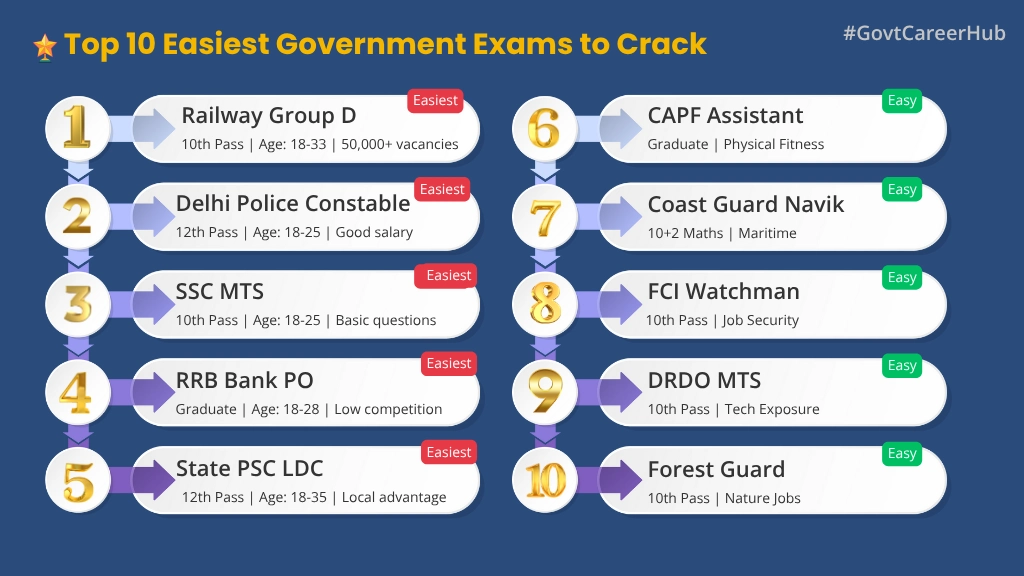
1. SSC Multi-Tasking Staff (SSC MTS)
Why it tops the list: Requires only 10th pass qualification with straightforward questions testing basic concepts.
Key Details:
- Education: 10th pass
- Age Limit: 18-25 years
- Salary: ₹18,000-22,000 per month
- Exam Pattern: 100 questions in 90 minutes (Session I: no negative marking; Session II: with negative marking)
- Posts: Peon, Daftary, Jamadar, Junior Gestetner Operator, Chowkidar, Safaiwala, Mali
Reality Check: While the exam is manageable, you’ll still need 3-4 months of consistent preparation focusing on numerical ability, reasoning, and general awareness.
Smart Tip: Practice time management—90 minutes for 100 questions means less than one minute per question.
2. Railway Recruitment Board Group D (RRB Group D)
Why it’s accessible: Massive vacancies (often 50,000+), basic syllabus, and straightforward question patterns.
Key Details:
- Education: 10th pass with ITI or equivalent
- Age Limit: 18-33 years (extendable for reserved categories)
- Salary: ₹18,000-25,000 per month (Level 1)
- Exam Pattern: CBT (Computer-Based Test) with 100 questions covering Mathematics, General Science, General Intelligence, and General Awareness
- Posts: Track Maintainer, Helper, Assistant Pointsman, Gateman
Success Strategy: The large number of vacancies significantly improves your odds. Focus on NCERT books (Classes 8-10) for Mathematics and General Science.
Physical Test: Be prepared for Physical Efficiency Test (PET) after clearing the written exam.
3. SSC Combined Higher Secondary Level (SSC CHSL)
Why 12th pass students prefer it: Decent salary, office-based postings, and no technical degree required.
Key Details:
- Education: 12th pass
- Age Limit: 18-27 years
- Salary: ₹19,900-44,900 per month (Grade Pay ₹4,200-4,600)
- Exam Pattern: Tier I (100 questions), Tier II (Descriptive Paper), Tier III (Typing Test)
- Posts: Lower Division Clerk (LDC), Junior Secretariat Assistant (JSA), Postal Assistant, Data Entry Operator
Competitive Edge: Strengthen your English skills—this exam heavily tests grammar, vocabulary, and comprehension.
Important: Results typically take 8-12 months for final selection.
4. IBPS Clerk (Institute of Banking Personnel Selection)
Why banking aspirants love it: Stable banking career, good work-life balance, and regular recruitment.
Key Details:
- Education: Graduate (any discipline)
- Age Limit: 20-28 years
- Salary: ₹19,900-35,000 per month (plus allowances)
- Exam Pattern: Preliminary Exam (100 marks) + Mains Exam (200 marks)
- Work Environment: Air-conditioned offices in public sector banks
Time Management Tip: IBPS Clerk preliminary exam gives only 20 minutes per section—practice sectional timing rigorously.
Career Growth: After 2-3 years, clerks can appear for PO exams for promotions.
5. Railway Recruitment Board NTPC (Non-Technical Popular Categories)
Why it’s manageable: Better posts than Group D with only 12th pass requirement.
Key Details:
- Education: 12th pass (for Level 2-5 posts) / Graduates (for Level 6 posts)
- Age Limit: 18-33 years
- Salary: ₹19,900-35,400 per month
- Exam Pattern: CBT Stage I, Stage II, and Typing/Computer Test
- Posts: Commercial Apprentice, Traffic Apprentice, Goods Guard, Senior Clerk
Advantage: Free railway travel for employees and families—a significant hidden benefit.
6. IBPS RRB (Regional Rural Banks)
Why competition is lower: Rural posting preference naturally filters urban candidates.
Key Details:
- Education: Graduate
- Age Limit: 18-28 years (Officers), 18-28 years (Office Assistant)
- Salary: Office Assistant (₹15,000-19,000), Officers (₹23,700-42,000)
- Exam Pattern: Similar to IBPS Clerk but with lesser competition
Local Advantage: Knowing regional languages helps immensely in RRB exams and posting.
Realistic Expectation: Salaries are lower than mainstream banks, but job security remains excellent.
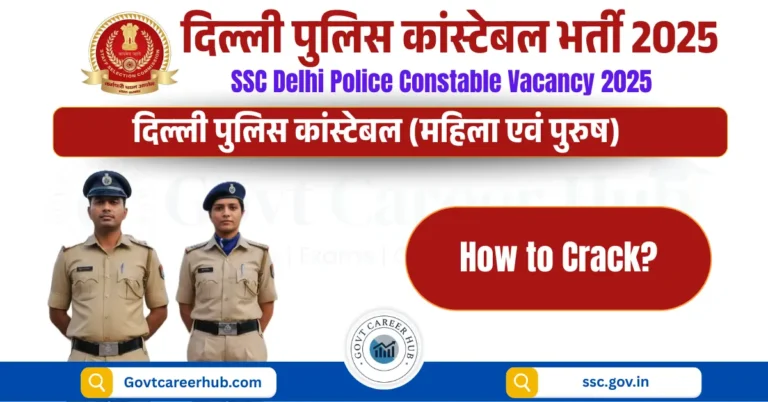
7. Delhi Police Constable (Staff Selection Commission)
Why Delhi residents prefer it: Good Delhi-specific salary package and local posting.
Key Details:
- Education: 12th pass
- Age Limit: 18-25 years (male), 18-27 years (female)
- Salary: ₹21,700-69,100 per month (with Delhi allowances)
- Selection Process: CBT, Physical Efficiency Test, Medical Examination
- Physical Standards: Height (Male: 170 cm, Female: 157 cm), Chest (Male: 80-85 cm)
Dual Preparation: Start physical training alongside academic preparation—don’t leave fitness for the last moment.
Female Candidates: 33% seats reserved for women with relaxed physical standards.
8. India Post GDS (Gramin Dak Sevak)
Why it’s unique: Merit-based selection primarily on 10th marks—no separate written exam in many states.
Key Details:
- Education: 10th pass with Mathematics and English
- Age Limit: 18-40 years
- Salary: ₹10,000-15,000 per month (varies by state)
- Selection: Merit list based on 10th percentage + local language knowledge
- Posts: Branch Post Master, Assistant Branch Post Master, Dak Sevak
Hidden Benefit: Part-time nature allows pursuing other opportunities simultaneously.
Important: Job security is lower compared to regular postal employees.
9. State PSC Lower Division Clerk (LDC) Exams
Why state exams work: Local candidates have knowledge advantage, less competition than central exams.
Key Details:
- Education: 12th pass (varies by state)
- Age Limit: 18-35 years (state-specific)
- Salary: ₹19,900-25,000 per month
- Exam Pattern: State-specific general knowledge, reasoning, mathematics, local language
State-Wise Popular Exams:
- UP Lekhpal (Uttar Pradesh)
- Rajasthan Patwari
- Maharashtra Talathi
- West Bengal Clerk
Strategic Advantage: Strong grasp of state history, geography, and current affairs gives 30-40% advantage.
10. CTET (Central Teacher Eligibility Test)
Why teaching aspirants choose it: Qualifies you for central government school teaching positions.
Key Details:
- Education: 12th pass (for Primary level), Graduate (for Upper Primary)
- Age Limit: No age limit
- Salary: ₹9,300-34,800 per month (as per 7th Pay Commission for KVS/NVS teachers)
- Exam Pattern: Paper I (Classes I-V), Paper II (Classes VI-VIII)
- Validity: 7 years from declaration date
Realistic Timeline: CTET qualification alone doesn’t guarantee job—you need to clear separate recruitment exams for KVS, NVS, or Central Schools.
Women Preference: Teaching remains one of the most preferred government jobs for women due to timing and environment.
Want to study more effectively? Check out Daily Routine and Time Table for Govt Job Aspirants (2025) for a perfect study plan.
State-Wise Easy Government Exam Opportunities
Uttar Pradesh
- UP Police Constable (Regular recruitment)
- UP Lekhpal (High demand)
- UP Primary Teacher (UPTET + Super TET)
Maharashtra
- Maharashtra Talathi (Revenue Department)
- MPSC Clerk Typist
- Maharashtra Police Constable
Bihar
- Bihar Police Constable (Large vacancies)
- Bihar Panchayat Secretary
- BPSC 70th Combined Competitive Examination
West Bengal
- WB Police Constable
- WBPSC Clerkship
- WB Primary TET
Preparation Strategies That Actually Work
Strategy 1: Match Exam to Your Profile
Don’t blindly follow trends. Analyze:
- Your educational qualification (10th/12th/Graduate)
- Strength areas (Mathematics/Reasoning/Languages)
- Physical fitness level (for police/military exams)
- Location preference (central vs. state posting)
Strategy 2: Target Multiple Similar Exams
Prepare for exam groups sharing similar syllabi:
- Banking Group: IBPS Clerk + RRB + SBI Junior Associate
- SSC Group: SSC MTS + SSC CHSL + SSC GD
- Railway Group: RRB Group D + RRB NTPC
Strategy 3: Focus on High-Weightage Topics
Based on recent exam analysis:
- Mathematics: Simplification, Percentage, Profit-Loss, Time-Work, Data Interpretation
- Reasoning: Coding-Decoding, Series, Blood Relations, Puzzles, Seating Arrangement
- General Awareness: Current Affairs (last 6 months), Static GK, Government Schemes
- English: Reading Comprehension, Error Spotting, Fill in the Blanks
Strategy 4: Practice With Time Pressure
Mock tests under exam conditions are non-negotiable:
- Take 2-3 full-length mocks per week
- Analyze wrong answers immediately
- Focus on improving accuracy over speed initially
- Gradually reduce solving time per question
Strategy 5: Stay Updated With Current Affairs
15-20 minutes daily investment:
- Read one national newspaper (The Hindu, Indian Express)
- Follow government scheme updates on PIB India
- Track monthly current affairs compilations
Enhance your study routine using Best Mobile Apps for Government Exam Preparation 2025 – Free & Paid Options — perfect for self-learners.
Common Mistakes That Kill Chances (Avoid These)
Mistake 1: Choosing Exams Based Only on Perceived Easiness
Solution: Consider your genuine interest and career goals. An “easy” exam leading to work you hate creates long-term dissatisfaction.
Mistake 2: Neglecting Physical Preparation
Solution: For exams requiring physical tests (Police, Defence, Railways), start fitness training 6 months in advance—not after clearing the written exam.
Mistake 3: Ignoring Negative Marking
Solution: Accuracy matters more than attempting all questions. Calculate your risk-reward ratio for each guess.
Mistake 4: Over-Relying on Coaching Classes
Solution: Self-study with quality resources often works better for these “easier” exams. Save coaching fees for truly complex exams like UPSC.
Mistake 5: Not Reading Official Notifications Carefully
Solution: Eligibility criteria, exam pattern changes, and important dates are in official notifications—read them thoroughly before starting preparation.
Essential Free Resources (Bookmark These)
Official Websites
- SSC: ssc.gov.in
- RRB: rrbcdg.gov.in
- IBPS: ibps.in
- UPSC: upsc.gov.in
Free Mock Tests
- Testbook (Limited free tests)
- Oliveboard (Section-wise practice)
- Gradeup (Daily quizzes)
Current Affairs
- Affairs Cloud (Daily updates)
- GK Today (Weekly compilations)
- PIB India (Government schemes)
Study Materials
- NCERT Books (Classes 6-10 for basics)
- Previous Year Papers (Last 5 years)
- YouTube Channels (Adda247, Study IQ, Unacademy)
Realistic Preparation Timelines
3-Month Intensive Plan (For Basic Exams)
Month 1: Complete syllabus coverage
- Week 1-2: Mathematics and Reasoning
- Week 3-4: General Awareness and English/Hindi
Month 2: Topic-wise practice
- Daily 2-hour practice sessions
- Weekly 1 full-length mock test
- Error analysis and improvement
Month 3: Revision and test series
- Daily revision of notes
- 3-4 mock tests per week
- Current affairs daily update
6-Month Comprehensive Plan (For Competitive Exams)
Months 1-2: Strong foundation building
- Conceptual clarity in all subjects
- Basic level question practice
- Create personal notes
Months 3-4: Advanced practice
- Previous year papers (last 10 years)
- Difficulty level progression
- Speed building exercises
Months 5-6: Exam simulation
- Full-length mock tests (20+)
- Time management perfection
- Last-minute revision strategy
Financial Planning for Government Exam Preparation
Budget-Friendly Approach
Study Materials: ₹2,000-3,000
- Previous year papers compilations
- One standard book per subject
- Current affairs magazine subscription
Online Resources: ₹1,500-3,000/year
- One quality test series platform
- PDF notes and study materials
Total Investment: ₹3,500-6,000 for 6-month preparation
Return on Investment: A government job offers lifetime earnings of ₹1-2 crores with pension benefits—exceptional ROI.
The Honest Reality About “Easy” Government Exams
Let’s address the elephant in the room: competition is increasing every year.
According to data from Career360’s Exam Analysis, even “easy” exams now see:
- SSC MTS: 30-40 lakh applications for 8,000-10,000 posts
- RRB Group D: 1-1.5 crore applications for 1 lakh posts
- IBPS Clerk: 25-30 lakh applications for 5,000-8,000 posts
What this means for you:
- “Easy” doesn’t mean “no preparation needed”
- Focus on standing out in the top 1-2% of candidates
- Quality preparation matters more than ever
- Consistent effort beats last-minute cramming
Success Stories: Learning From Real Candidates
Priya Sharma (SSC MTS 2024): “I failed twice before succeeding. My mistake was treating it as ‘easy’—once I gave it serious 4-month preparation, everything changed. Daily practice and mock tests made the difference.”
Rajesh Kumar (RRB Group D 2024): “Being from a Hindi medium background, I struggled with English. I dedicated 30 minutes daily just for English basics. After 6 months, I scored 88/100 in the exam. Consistency matters more than brilliance.”
Anjali Verma (IBPS Clerk 2024): “I applied for 7 different banking exams simultaneously. Preparing for multiple exams with similar syllabi increased my confidence and chances. Got selected in 2 banks!”
Upgrade your preparation with free video lessons – check out Best YouTube Channels for Government Exam Preparation 2025 – Free Study Resources.
Your Action Plan: Start Today
Step 1: Self-Assessment (Day 1-2)
- List your qualifications and strengths
- Identify 3-4 exams matching your profile
- Download official notifications
Step 2: Resource Gathering (Day 3-5)
- Purchase/download essential books
- Bookmark free resource websites
- Join relevant Telegram channels for updates
Step 3: Study Plan Creation (Day 6-7)
- Create realistic daily targets
- Allocate time for each subject
- Schedule weekly mock tests
Step 4: Consistent Execution (Next 3-6 months)
- Stick to your schedule (80% adherence is realistic)
- Track daily progress
- Adjust strategy based on mock test performance
Step 5: Final Month Push
- Intensive revision
- Daily mock tests
- Current affairs cramming
Frequently Asked Questions
Final Thoughts: Your Government Job Journey
The question “which government exam is easy to crack” has a personalized answer for everyone. What’s easy for someone strong in mathematics might be challenging for someone with language strengths.
Three truths about government exams in 2025:
- No shortcut exists—even “easy” exams need genuine preparation
- Competition is fierce—but consistent effort beats sporadic brilliance
- Multiple attempts are normal—don’t lose hope after one failure
Your dream sarkari naukri isn’t just about finding the easiest exam—it’s about finding the right exam that matches your profile and preparing smartly with dedication.
According to the National Career Service, over 2 lakh government vacancies are announced annually across various departments. The opportunities exist—what’s needed is focused preparation and realistic expectations.
Start your preparation today. Choose an exam, download the syllabus, purchase basic study material, and commit to 2-3 hours of daily focused study. In 6 months, you could be celebrating your government job selection.
Remember: Every government employee you see today was once in your position—dreaming, planning, and preparing. The only difference? They didn’t quit.
Ready to start your government job journey? Bookmark this guide, join our preparation community, and take the first step toward your sarkari naukri dream.
Useful Resources:
- Ministry of Personnel, Public Grievances and Pensions (Official recruitment information)
- Employment News (Weekly government job compilation)
- State-specific PSC websites for local opportunities
Last Updated: November 2025 | Next Update: Monthly with new exam notifications and cutoff trends
These articles might be helpful:
- Sarkari Naukari Ki Tyari Kaise Kare- Best Tips
- Top Government Jobs Without Exams in 2025 – Merit Based List