If you’re planning to appear for the Staff Selection Commission Combined Graduate Level exam, understanding the SSC CGL syllabus 2026 is your first step toward success. This exam opens doors to various Group B and C posts in government departments, making it one of the most sought-after competitive exams in India.
Let me break down the entire syllabus in a way that makes sense and helps you plan your study strategy effectively.
Understanding the SSC CGL Exam Pattern
Before diving into the syllabus, you should know that SSC CGL has multiple tiers. The syllabus varies across these stages, and knowing what to expect at each level helps you prepare smarter.
The exam consists of:
- Tier-I: Computer-based examination (objective type)
- Tier-II: Computer-based examination (objective type)
- Tier-III: Descriptive paper (Pen and Paper mode)
- Tier-IV: Skill Test/Computer Proficiency Test
👉 Read: SSC CGL Preparation for 2026 – Complete Strategy Guide
SSC CGL Tier-I Syllabus Breakdown
Tier-I tests your fundamental knowledge across four major sections. Let’s look at what each section covers.
English Language
This section tests your command over the English language. You’ll face questions on:
- Spotting errors in sentences
- Filling in the blanks with appropriate words
- Synonyms and antonyms
- Idioms and phrases
- One-word substitution
- Sentence improvement
- Active and passive voice
- Direct and indirect narration
- Sentence rearrangement
- Cloze test passages
- Reading comprehension
Pro tip: Reading newspapers like The Hindu or Indian Express daily improves your vocabulary and comprehension skills naturally.
General Intelligence and Reasoning
This section evaluates your logical thinking ability. The SSC CGL reasoning syllabus includes both verbal and non-verbal questions:
Verbal Reasoning Topics:
- Semantic analogy and classification
- Semantic series
- Word building
- Coding and decoding
- Critical thinking
- Problem-solving
- Emotional intelligence
- Social intelligence
Non-Verbal Reasoning Topics:
- Figural analogy and classification
- Figural series
- Space orientation
- Venn diagrams
- Punched hole and pattern folding
- Embedded figures
- Number series and classification
- Symbolic operations
Curious about earnings after SSC CGL? View the breakdown here: SSC CGL Salary Structure 2025 (Latest Update): In-Hand Salary, Pay Level, and Post-wise Breakdown.
Quantitative Aptitude
Mathematics forms a crucial part of the SSC CGL maths syllabus. Here’s what you need to master:
Number Systems: You’ll work with whole numbers, decimals, fractions, and understand relationships between numbers.
Arithmetic: This is the heaviest section, covering percentages, ratio and proportion, averages, simple and compound interest, profit and loss, discount, partnership, mixture and alligation, time and distance, and time and work problems.
Algebra: Basic algebraic identities, elementary surds, and graphs of linear equations.
Geometry: Properties of triangles (including centers), congruence and similarity, circles with chords and tangents, and common tangents to circles.
Mensuration: Area and volume calculations for triangles, quadrilaterals, polygons, circles, prisms, cones, cylinders, spheres, and pyramids.
Trigonometry: Trigonometric ratios, complementary angles, height and distance problems, and standard identities like sin²θ + cos²θ = 1.
Statistical Charts: Interpreting histograms, frequency polygons, bar diagrams, and pie charts.
For practice problems and concept clarity, websites like Khan Academy offer excellent free resources.
General Awareness
This section tests your knowledge about current affairs and general knowledge. The GK syllabus for SSC CGL covers:
- Current events and news
- Indian history and culture
- Geography of India and neighboring countries
- Economic developments and policies
- Scientific research and innovations
- Important days and events
- Government schemes and initiatives
Important note: Candidates with 40% or above visual disability won’t have questions involving maps, graphs, diagrams, or statistical data in the General Intelligence and Quantitative Aptitude sections.
If you’re just starting your SSC CGL journey, follow this Daily Time Table for SSC CGL Preparation for Beginners: Your Complete Roadmap to Success to stay consistent and focused.
SSC CGL Tier-II Syllabus Details
Tier-II digs deeper into specific subjects. The exam pattern for SSC CGL Tier-II has changed over the years, so staying updated is important.
Mathematical Abilities
The maths section in Tier-II covers similar topics as Tier-I but with greater depth and difficulty:
- Number systems and computations
- Fundamental arithmetic operations
- Algebra and linear equations
- Geometry concepts
- Mensuration problems
- Trigonometry applications
- Statistics and Probability (this is additional): Measures of central tendency (mean, median, mode), standard deviation, and basic probability calculations
Reasoning and General Intelligence
The reasoning syllabus remains similar to Tier-I, testing both verbal and non-verbal reasoning abilities with more complex questions.
English Language and Comprehension
Tier-II English section is more detailed:
- Vocabulary and grammar rules
- Sentence structure
- Comprehension passages (at least two paragraphs – one simple narrative and one based on current affairs or editorial content)
- All Tier-I topics with increased difficulty
General Awareness
The general awareness section continues testing your knowledge of current affairs, history, geography, economics, and scientific developments related to India and neighboring countries.
Computer Knowledge
This is an important addition in Tier-II. The computer proficiency syllabus includes:
Computer Basics: Computer organization, CPU, input/output devices, memory types, backup devices, ports, Windows Explorer, keyboard shortcuts.
Software: Windows OS basics, MS Word, MS Excel, PowerPoint fundamentals.
Internet and Email: Web browsing, searching, downloading, uploading, email management, and e-banking basics.
Networking and Security: Basic networking concepts, protocols, security threats (hacking, viruses, worms, Trojans), and preventive measures.
The National Institute of Electronics and Information Technology website provides useful computer literacy resources.
Tier-III: Descriptive Paper
Tier-III is a pen-and-paper test conducted in English or Hindi. You’ll need to write:
- Essay writing (200-250 words)
- Letter writing (formal/informal)
- Application writing
- Precis writing
This tests your writing skills, so practicing regularly is essential.
Tier-IV: Skill Test
Depending on the post you’re applying for, you might need to take:
Data Entry Speed Test (DEST): For Tax Assistants, you’ll need to type 2000 key depressions in 15 minutes (8000 key depressions per hour).
Typing Test: For posts requiring typing skills, you need to achieve 35 words per minute in English or 30 words per minute in Hindi (10-minute duration).
Candidates eligible for scribes get 5 minutes of additional compensatory time, making their test duration 15 minutes.
Exemption note: Persons with disabilities who are permanently unfit for typing tests can apply for exemption with proper medical certificates.
How to Approach the SSC CGL Syllabus 2026
Now that you know what’s in the syllabus, here’s how to tackle it:
Start with your strong areas: Build confidence by mastering topics you’re already comfortable with.
Identify weak sections early: The sooner you address your weak points, the more time you have to improve them.
Follow a topic-wise approach: Don’t jump between subjects randomly. Complete one topic thoroughly before moving to the next.
Practice previous year papers: Understanding question patterns gives you a massive advantage. The SSC official website occasionally releases sample papers.
Take regular mock tests: Simulate exam conditions to build speed and accuracy.
Stay updated with current affairs: Dedicate 30 minutes daily to reading news and noting important events.
Common Mistakes to Avoid
Students often struggle because they:
- Try to cover everything superficially instead of mastering basics
- Ignore the descriptive paper preparation until the last moment
- Don’t practice enough mock tests
- Skip revision thinking they’ll remember everything
- Neglect computer knowledge (it’s easier to score here!)
Timeline for Preparation
If you’re starting now, here’s a realistic timeline:
3-4 months before exam: Cover the entire syllabus once, focusing on understanding concepts.
2-3 months before exam: Complete second revision, solve topic-wise questions, and identify problem areas.
1 month before exam: Take full-length mock tests, revise formulas and shortcuts, and brush up current affairs.
Last week: Quick revision of notes, important formulas, and staying calm.
Additional Resources Worth Checking
While I won’t recommend specific coaching institutes, these official and educational resources are genuinely helpful:
- NCERT Books (Class 6-10) for basic concept building
- PIB India for government schemes and policies
- Economic Survey for economic awareness
- Previous year question papers from various government exam portals
Frequently Asked Questions About SSC CGL Syllabus 2026
Final Thoughts
The SSC CGL syllabus 2026 might seem overwhelming at first glance, but remember that lakhs of students clear this exam every year. What sets successful candidates apart isn’t just hard work—it’s smart work combined with consistent effort.
Focus on building strong fundamentals, practice regularly, and don’t neglect any section thinking it’s too difficult or too easy. Every mark counts in this competitive exam.
The syllabus hasn’t drastically changed over the years, which means there’s plenty of study material and previous papers available. Use them wisely, stay focused on your preparation strategy, and keep your goal in sight.
Your journey to a government job starts with understanding this syllabus inside out. Take it one topic at a time, stay consistent, and success will follow. All the best for your SSC CGL preparation!
Note: Always check the official SSC notification for any updates to the exam pattern or syllabus before starting your preparation. Exam patterns can be modified by the commission.
Read Also:
- 📝 SSC CGL vs Bank PO: Which is Tough? A Complete Comparison for Aspirants
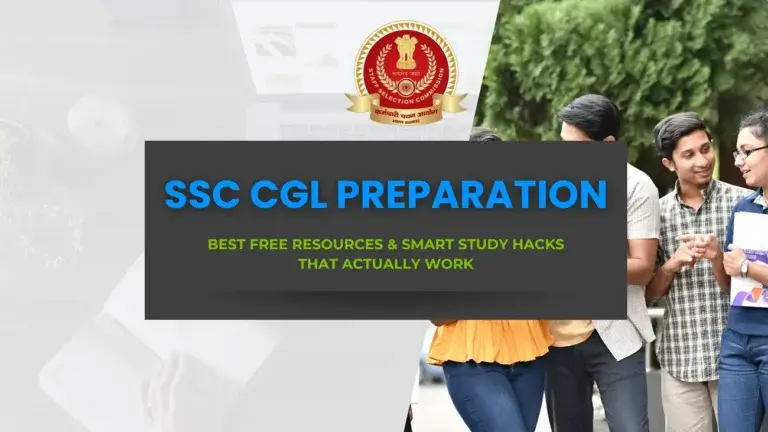
- SSC CGL Preparation on a Budget: Best Free Resources & Smart Study Hacks That Actually Work
- Best Books for SSC CGL Preparation at Home: Complete Subject-Wise Guide